
Most small business owners reach the same point. The admin has piled up, you’re answering emails at 11pm, and the obvious fix is to hire someone.
Sometimes that’s exactly the right call. But before you write the job ad, it’s worth an hour with a notepad, because a lot of what’s piling up is often the same small tasks, done the same way, over and over. That part of the job might not need a person at all. And the part that does needs a different kind of person than you’d think.
Here’s how I’d work it out.
Step 1: write down everything the new hire would do
Be specific. Not “admin”, but the actual tasks:
- Copy new orders into the warehouse spreadsheet
- Reply to “where’s my order?” emails
- Chase unpaid invoices
- Update stock levels from supplier files
- Book and reschedule client calls
- Send the weekly report to the team
- Deal with the customer who’s upset about a late delivery
- Sort out the supplier who shipped the wrong thing
For each one, note roughly how many hours a week it takes.
Step 2: split the list in two
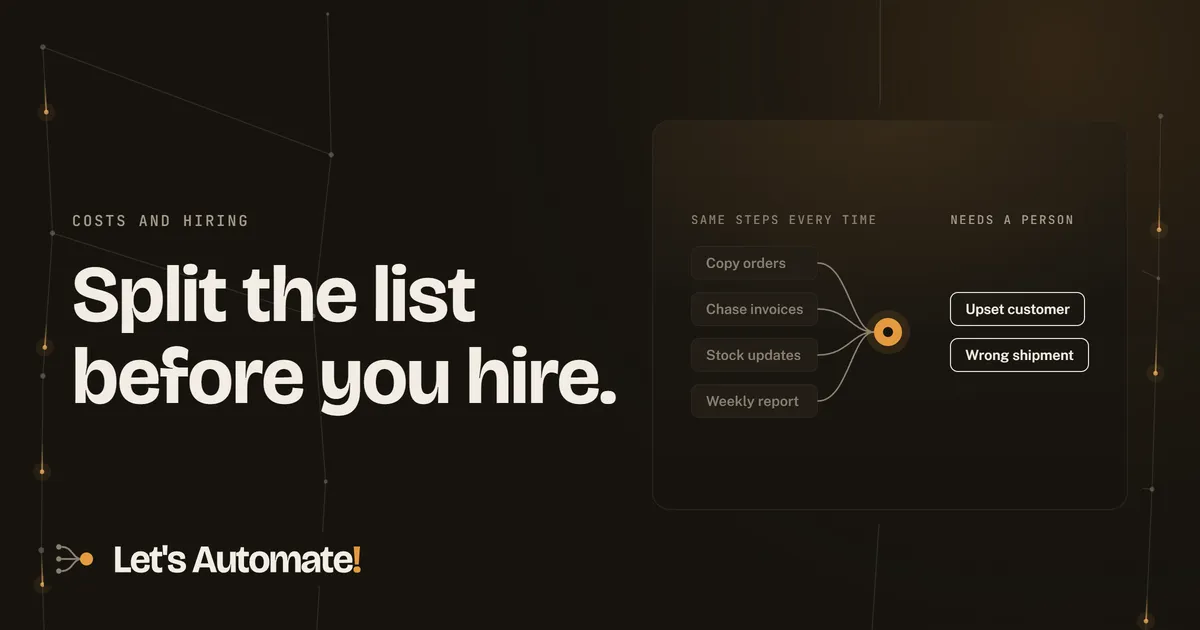
Go through the list and ask one question about each task: does this need a judgement call every time, or does it follow the same steps every time?
Copying orders into a spreadsheet follows the same steps every time. So do stock updates, invoice reminders, booking calls and the weekly report. These are the repeatable tasks.
The upset customer and the wrong shipment are different. Every one is a little different, and they need someone who can listen, decide and fix it. These are the people tasks.
On most lists I see, the repeatable column is longer than people expect.
Step 3: put a number on the repeatable column
For the repeatable tasks, add up the hours and do this:
hours a week × what an hour of someone’s time costs you × 52 = what those tasks cost you a year
Say it comes to 15 hours a week, and you’d be paying around $20 an hour. That’s $15,600 a year, every year, for tasks that follow the same steps each time.
Now compare that with automating them. An automation is a one-time build plus a monthly fee for the tools it runs on, and it does the same work every day, at 2am, on weekends and during holidays, without getting it wrong on a busy Friday.
Step 4: decide who you’re actually hiring
This is the part that matters. Once the repeatable tasks are handled, look at what’s left.
Maybe what’s left is a few hours a week you can handle yourself. In that case, you might not need the hire yet.
Or maybe what’s left is a real job: customer relationships, supplier problems, the decisions you keep putting off. That’s still a hire worth making. But you’re now hiring for a better role, one where the person spends their time on work that needs a person instead of copying numbers between screens. That’s a job people want to stay in, and it’s a much better use of your money.
Either way, you’ve made the decision with numbers instead of a gut feeling.
What automation can’t replace
I build automations for a living, so it’s fair to say where they stop.
- Judgement. Deciding whether a customer gets a refund, which supplier to drop, or what to do when something unexpected happens. An automation can gather the information and flag it, but a person should decide.
- Relationships. Your best customers and suppliers want to talk to a human, and they should.
- Things that change every time. If a task is different each time you do it, it’s usually not worth automating.
- Fixing a messy process. Automating a process nobody agrees on just makes the mess run faster. Sometimes the first step is writing down how it should work.
The goal was never to replace people. It’s to stop the repetitive work from eating the time of the people who make decisions, including you.
A quick way to start
Pick the one task on your list that’s most repetitive and most annoying. That’s usually the best first automation, because you’ll feel the difference within a week.
If you’d like a second opinion on your list, book a free 30-minute call. Walk me through what’s piling up, and I’ll tell you honestly which parts are worth automating and which ones need a person.
