
If your store’s stock comes from suppliers, someone on your team is probably keeping the two in step by hand. They open the supplier’s file, check it against the store, and fix whatever changed. It feels like a small job. Twenty minutes here, an hour there.
It usually isn’t small. I built an automation that replaced exactly this job for a home goods e-commerce brand, and before the build, two people were spending 8 to 10 hours a day each on it, five days a week. That’s 80 to 100 hours a week of checking numbers. Nobody had added it up, because it had grown one supplier and one product at a time.
So here’s how to add yours up.
Step 1: count the hours honestly
Most owners underestimate this one, because the work is spread across people and days. Don’t guess from memory. For one normal week, ask whoever does it to jot down how long each round takes.
A typical round looks something like this:
- Open the supplier’s stock email or log in to their portal.
- Filter the list down to the products you actually carry.
- Export your store’s current inventory.
- Compare the two, usually in a spreadsheet.
- Update every product that changed, one at a time.
- Repeat for the next supplier, which shares its stock in a completely different way.
Then do the maths:
hours a week × what an hour of that person’s time costs you × 52 = the yearly cost
For “what an hour costs”, use their full cost to you, not just the hourly wage. If you’re not sure, the wage is a fine conservative starting point.
Even at a modest 10 hours a week and $20 an hour, that’s $10,400 a year spent comparing spreadsheets. At the 80 hours a week I saw, it’s a full team’s worth of time.
Step 2: add the costs that don’t show up on a timesheet
The hours are the cost you can measure. These are the ones you can’t, until they bite.
Oversells. When a supplier runs out and your store doesn’t know yet, you sell something you can’t ship. That means a cancelled order, a refund, an apology email and a customer who may not come back. If you also sell on marketplaces, they keep track of how often you cancel, so it can cost you there too.
Typos. Hand-typed quantities go wrong now and then. It’s not a people problem. Nobody can check hundreds of numbers a day and get every one right. A 50 typed as 500 sits there quietly until someone orders it.
The lag. A manual check happens when someone gets to it. Stock changes whenever it changes. The gap between the two is where oversells come from.
The work that isn’t getting done. This is the big one. The people doing the checking are usually capable of much more useful work. Every hour spent comparing files is an hour not spent on customers, suppliers or the decisions that actually grow the store.
Step 3: compare it with what an automation costs
An inventory sync is a one-time build plus a small running cost for the tools it runs on. Once it’s live, it does the same job every night (or every hour, if you need it) without anyone opening a laptop.
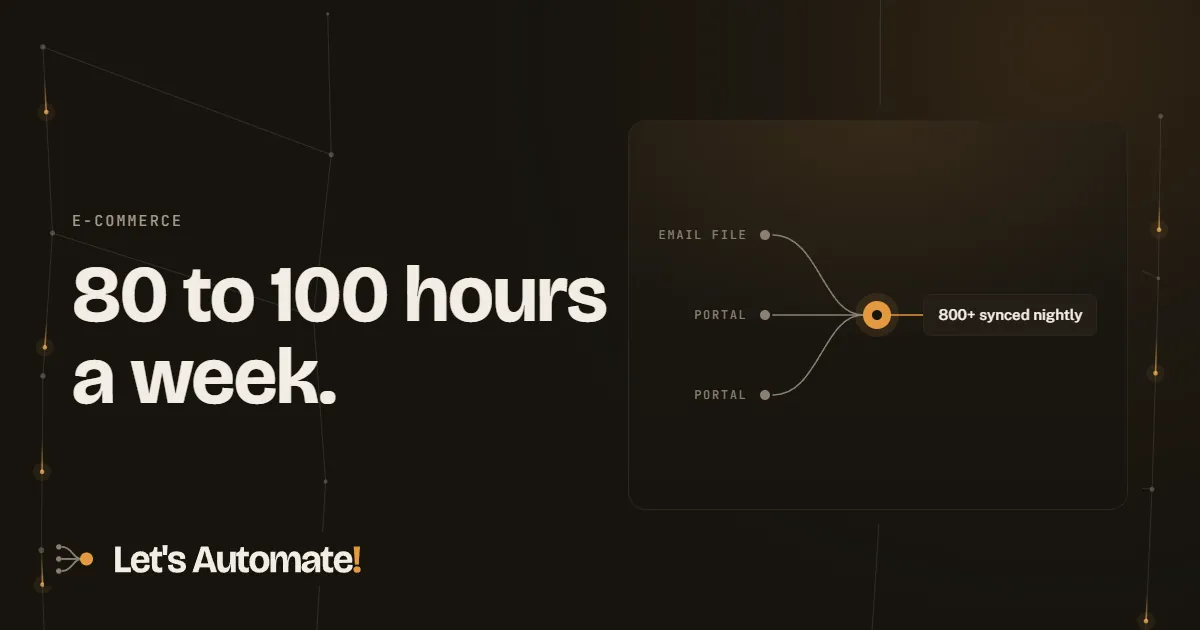
In the build I mentioned, each supplier got its own route in, because each one shared stock differently. One emails a file every night, so the automation picks it up from the inbox, reads it, keeps only the products the store carries, and updates just the ones that changed. The other two only show stock behind a login, so a small scraper logs in the way a person would and reads it. All three end in the same place: the right number on the store by morning, and a short summary to the team saying what changed.
The results: 800+ products synced every night, zero oversells since launch, and two people back on work that actually needs a person. You can read the full case study here.
Signs it’s time to automate yours
You don’t need three suppliers for this to be worth it. If any of these sound familiar, it’s worth a conversation:
- Someone on your team spends more than an hour a day checking or updating stock.
- You’ve oversold something in the last few months because the store didn’t know it was gone.
- Your stock comes from more than one place, and each supplier shares it differently.
- The person doing it has stopped enjoying their job, or it’s pushing them into overtime.
- You’ve held off adding products or suppliers because “keeping stock updated would be a nightmare”.
And when it isn’t worth it
If you carry a handful of products from one supplier that rarely runs out, a quick weekly check might be all you need. An automation is worth building when the task is frequent, repetitive and costly when it goes wrong. If yours isn’t, I’d rather tell you that than build something you don’t need.
Want me to look at yours?
Tell me how your stock gets updated today, and I’ll tell you honestly whether it’s worth automating, what it would take, and roughly how long. Book a free 30-minute call, or try the checker on the home page first.
